Commercial · Toronto
Commercial-Grade Lock Replacement in Toronto
An inspection report flagged the rear exit as needing hardware that opens with one motion and no key, and that door currently has an ordinary keyed knob on the inside.
Commercial-Grade Lock Replacement
In plain words
Businesses often reach this service after something specific happens: a break-in, a departing employee holding a working key, a lease turnover, or an inspector's note about the rear exit. Whatever the trigger, the work itself follows the same order. The locksmith assesses the door and its current hardware, agrees with an authorized contact on the keying the new lock should follow, fits hardware rated for the opening's construction and use, and connects it to anything else already wired into that door, such as an alarm contact or an access-control reader, before testing and handing the keys over.
How the visit goesThe electric strike buzzes the moment the receptionist presses the release button, but the door still needs a shoulder to get past the latch, as though the two pieces were never matched.
Toronto
How the visit goes
Confirming who can authorize the work
Before any hardware is opened up, the locksmith confirms who is speaking for the business: an owner, a property manager, or a staff member the account recognizes as authorized to order and pay for the work. On a multi-tenant building this also means confirming which doors belong to which lease. This step exists for the same reason a home lockout starts with identification: a business's security is only as good as its record of who was allowed to change it, and a clear authorization at the start keeps that record clean.
Preserving the door's required behaviour
On a door required to close and latch on its own, the new hardware is installed and the closer adjusted so that behaviour still happens after the work is done: the door swings shut, the latch engages, and nothing about the new lock lets it be secured open in daily use. On an exit route where listed push-type hardware is required, the entire route from that door to the outside is checked so the new hardware fits the same standard as the rest of the path rather than becoming the one mismatched link in it.
A door rated for the job it does
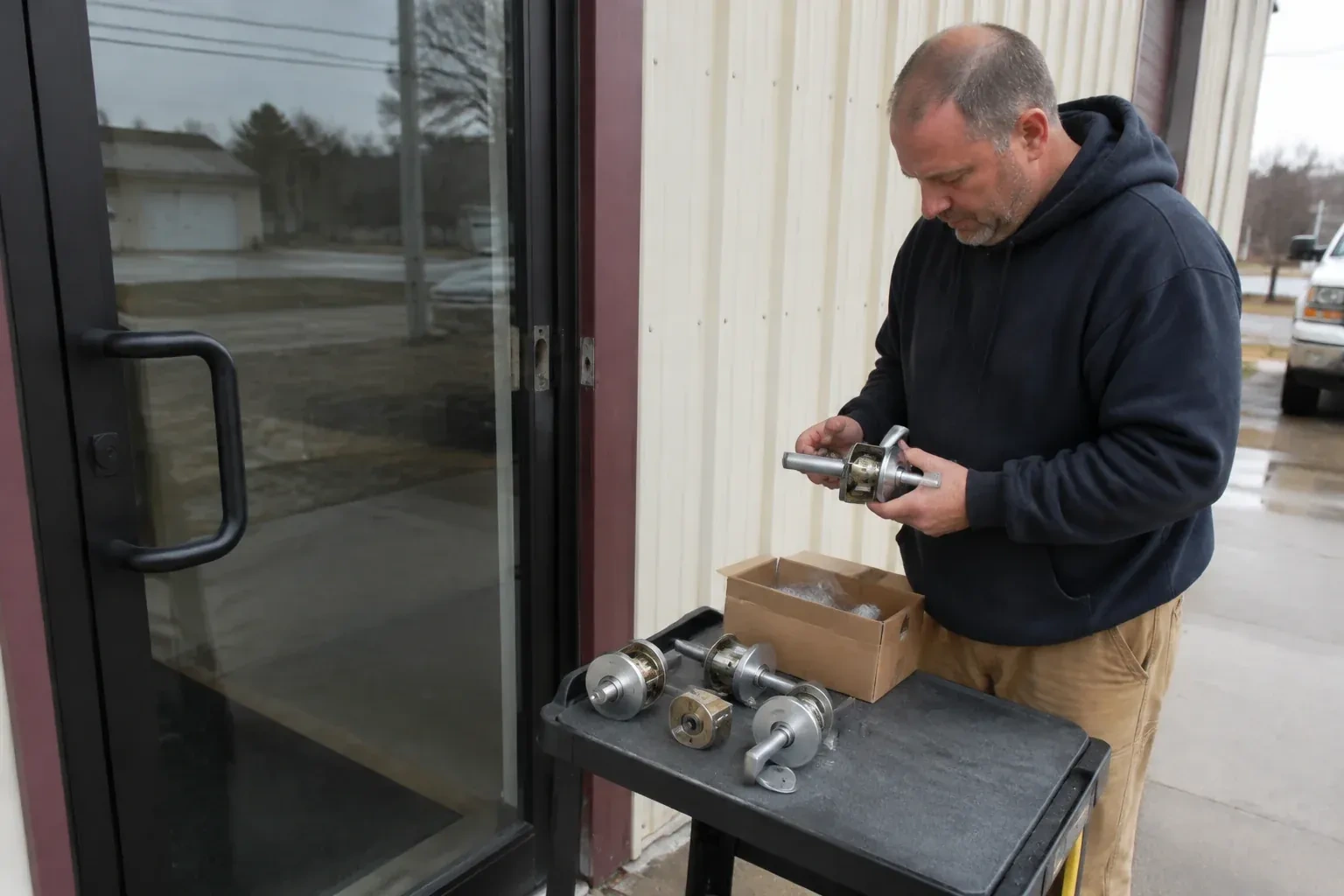
The business is left with hardware sized to how the door is actually used: a mortise lock body or heavy cylindrical lockset that can take the traffic of a busy entrance, or a narrow-stile lock built for the aluminum frame it is mounted in rather than adapted to it. Staff can be shown how the new hardware feels different from the old one, whether that is a firmer latch, a smoother deadbolt throw, or a different key profile, so nobody is caught off guard by hardware that behaves differently from what they are used to.
Commercial-Grade Lock Replacement
In the van
- Mortise lock body
- Strike plates and keepers
- Key cutting and coding machine
- Restricted keyway cylinder
- Interchangeable-core cylinder
What affects the quote
Same fees day, night or weekend
1Number of doors involved
One entrance is the simplest case. Bringing several doors, or several branch locations, onto matching hardware or one key system in the same engagement is priced across the whole set rather than door by door in isolation.
2Removal of old hardware
Whether old locks, cylinders and strikes are left with the business, disposed of, or kept as spares for a wider system is a small choice that can affect the time and scope named in the quote.
3Electrified hardware and access-control integration
An electric strike, maglock or reader tie-in adds parts and testing time beyond a purely mechanical lock, and the quote separates that electrified work from the mechanical hardware so each is clear on its own.
Commercial-Grade Lock Replacement: questions
Does an electric strike need to match a specific lock function?
Yes. An electric strike has to suit the latch or deadlatch type it will receive, the door's handing and swing, and whether the application needs fail-safe or fail-secure operation, meaning whether the door should unlock or stay locked if power is lost. Choosing a strike without checking these against the mechanical lock is a common reason a door releases electronically but still binds mechanically.
Do exit devices need any ongoing attention after installation?
Yes. Exit devices and panic hardware are mechanical assemblies that see heavy use on a required exit, so periodic checking that the latch engages fully, the release bar moves freely, and any electrified or alarmed function still triggers correctly is worth building into the same schedule as other fire-safety equipment in the building.
How does this service differ from a home lockout or residential rekey?
A home lockout or residential rekey is usually about one door and one household's keys. Commercial-grade lock replacement more often involves a system, several doors, a master key structure, and sometimes a fire or exit rule the door has to satisfy, so the assessment, the hardware selected and the record kept at the end are all built around managing that wider structure rather than a single lock.
Commercial Locks
- Master Key System DesignOn the warehouse floor, a shift supervisor's key opens the loading dock, the tool crib and the…
- Access Control InstallationSomething went missing from the storeroom over a weekend, and when you ask who was in the building…
- Panic & Exit HardwareTwo doors used to swing as a pair at the community hall entrance, but one leaf has started closing…
Commercial-Grade Lock Replacement near you
Residents and business owners in Toronto can use this list to find the service that fits, then read what it involves before anyone comes out. Emergency openings are here. So are rekeys, lock changes, deadbolt and high-security upgrades, commercial door hardware, master keys, safes and key cutting.