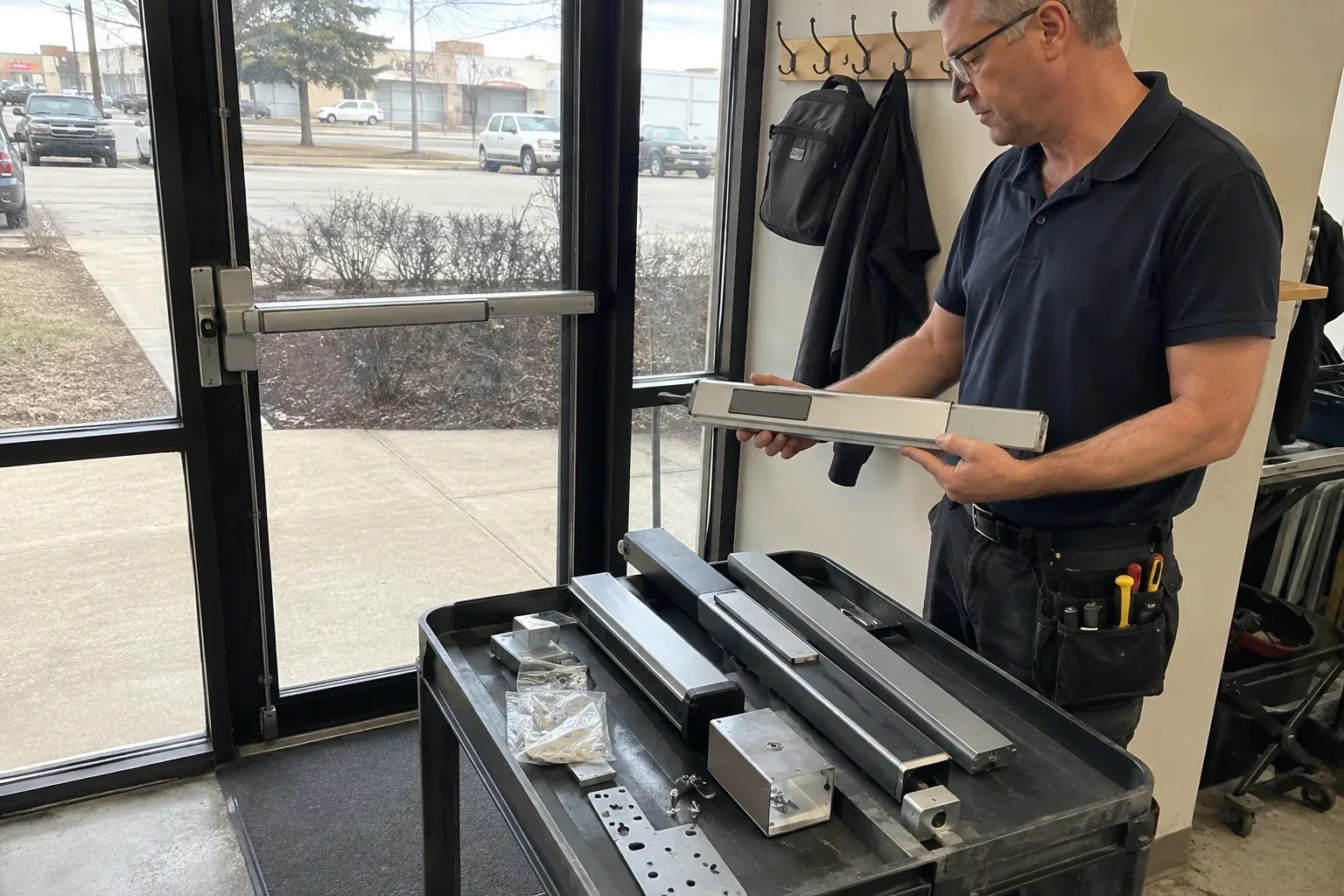
Commercial · Toronto
Panic & Exit Hardware
Two doors used to swing as a pair at the community hall entrance, but one leaf has started closing before the other, catching the astragal and leaving a gap wide enough to worry the caretaker.
Panic & Exit Hardware
In plain words
Electrified exit hardware adds a layer without changing the basic behaviour of the door: a person inside can still leave under one motion of the hand, every time. A request-to-exit switch tells an access-control panel that the pushpad or crossbar was actuated, usually paired with a door-position contact so the panel can also tell a normal exit from a forced or propped door. Electric latch retraction lets a fire-rated opening behave like a push-pull door for staff, provided it relatches automatically on a fire-alarm signal, since that kind of door never carries a mechanical dogging function. An alarm module sounds when the device is used.
How the visit goesAfter the fit-out, the gym floor now holds more people than the old office space ever did, and the exit door at the back still has the same turn-lock it had when the room held desks.
Toronto
How the visit goes
Occupancy, fire rating and the authority reviewing the space
The assessment records the occupancy type and calculated occupant load for the room the door serves, whether the door sits in a fire separation, and who the authority having jurisdiction is likely to be, whether that is a fire inspector, a building official or an insurer. These facts, not the door's appearance or its width alone, are what decide whether a releasing device is required, whether it must also be fire-rated exit hardware, and what documentation the finished installation should carry.
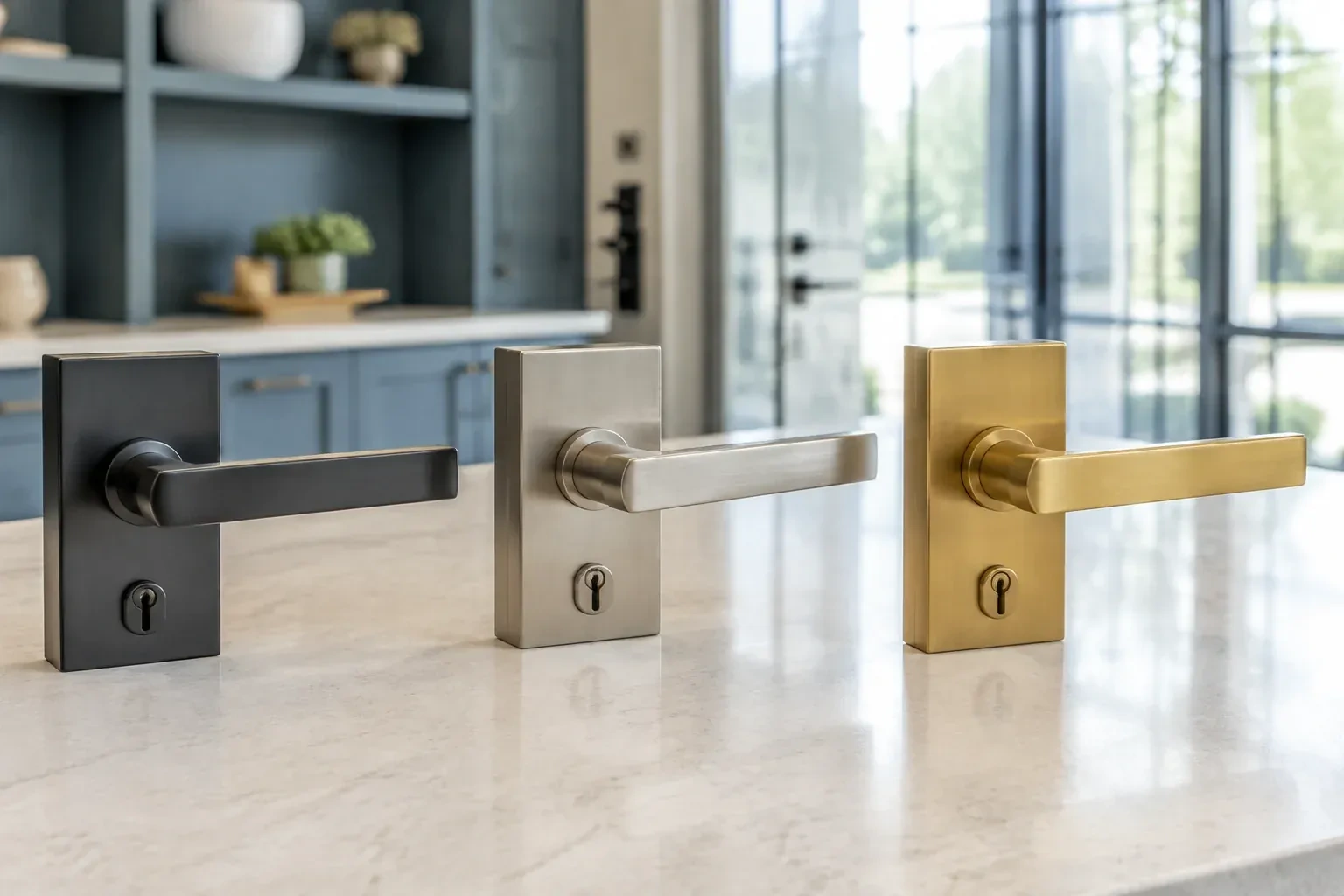
Fitting outside trim that still controls entry
The inside of the door stays simple: push to leave, every time. The outside gets whatever lets the right people in, a plain pull for a door nobody needs to unlock from outside, a lever with a key cylinder for staff entry, or a keyed cylinder alone where entry is occasional. Whichever trim is chosen, it operates entirely independently of the inside crossbar, so locking the outside never has any effect on a person's ability to leave from within.
A maintenance rhythm worth keeping
Exit devices are mechanical hardware and benefit from the same light attention as any other: a periodic check that the release force has not crept up, that the latch still seats fully, and that nothing has been added to the door that would block its exit function. Fire door assemblies carry their own inspection and testing rhythm, and folding the exit hardware into that same routine check keeps the whole opening, not just the lock, in the condition it was fitted in.
Panic & Exit Hardware
In the van
- Force gauge
- Through-fixings and mounting hardware
- Outside trim (pull, lever or cylinder)
- Rated exit device
- Request-to-exit switch
What affects the quote
Same fees day, night or weekend
1Removing hardware that should not remain
A padlock, hasp or extra deadbolt found on the door is removed and the resulting holes are filled or covered as part of the same visit, which is its own small task in the quote.
2Access-control integration
Where the door ties into an existing access-control panel, coordinating the exit hardware's signals with that system takes planning with whoever maintains it, which the quote accounts for separately from the device itself.
3Weatherproofing for an exterior opening
An exterior device, strike and trim built to handle temperature swings and moisture cost more as hardware than an equivalent interior-only set, and the quote reflects that difference in the parts themselves.
Panic & Exit Hardware: questions
What happens with a pair of doors instead of one?
It depends on the pair. Some latch independently and need nothing extra. Where the hardware calls for a set closing order, a coordinator lets the two leaves close in the right sequence, letting the active leaf's device seat properly into a strike carried on the inactive leaf, or into an astragal. Alternatively, the centre mullion can be removed and a vertical-rod device fitted to each leaf, turning the pair into one wide exit. Whichever applies, both leaves are tested working together, not one at a time.
What is dogging, and can every door have it?
Dogging holds the device's latch retracted so the door works as a simple push-pull for a period, useful during business hours on a busy entrance. It is not available on fire-rated openings, because a fire door must keep an active latch at all times; on those doors, electric latch retraction achieves a similar push-pull convenience without ever leaving the latch mechanically held back.
How is occupant load actually counted for this decision?
Occupant load is calculated from the floor area and the intended use of the room, using published factors for that occupancy type, rather than a headcount taken on a busy night. A building official or a locksmith familiar with the calculation can work through it for a specific room, and the result is what decides whether the exit doors serving that room need a releasing device.
Commercial Locks
- Master Key System DesignOn the warehouse floor, a shift supervisor's key opens the loading dock, the tool crib and the…
- Access Control InstallationSomething went missing from the storeroom over a weekend, and when you ask who was in the building…
- Commercial-Grade Lock ReplacementAn inspection report flagged the rear exit as needing hardware that opens with one motion and no…
Panic & Exit Hardware near you
Residents and business owners in Toronto can use this list to find the service that fits, then read what it involves before anyone comes out. Emergency openings are here. So are rekeys, lock changes, deadbolt and high-security upgrades, commercial door hardware, master keys, safes and key cutting.