Commercial · Cliffcrest
Panic & Exit Hardware in Cliffcrest
Two doors used to swing as a pair at the community hall entrance, but one leaf has started closing before the other, catching the astragal and leaving a gap wide enough to worry the caretaker.
Panic & Exit Hardware
In plain words
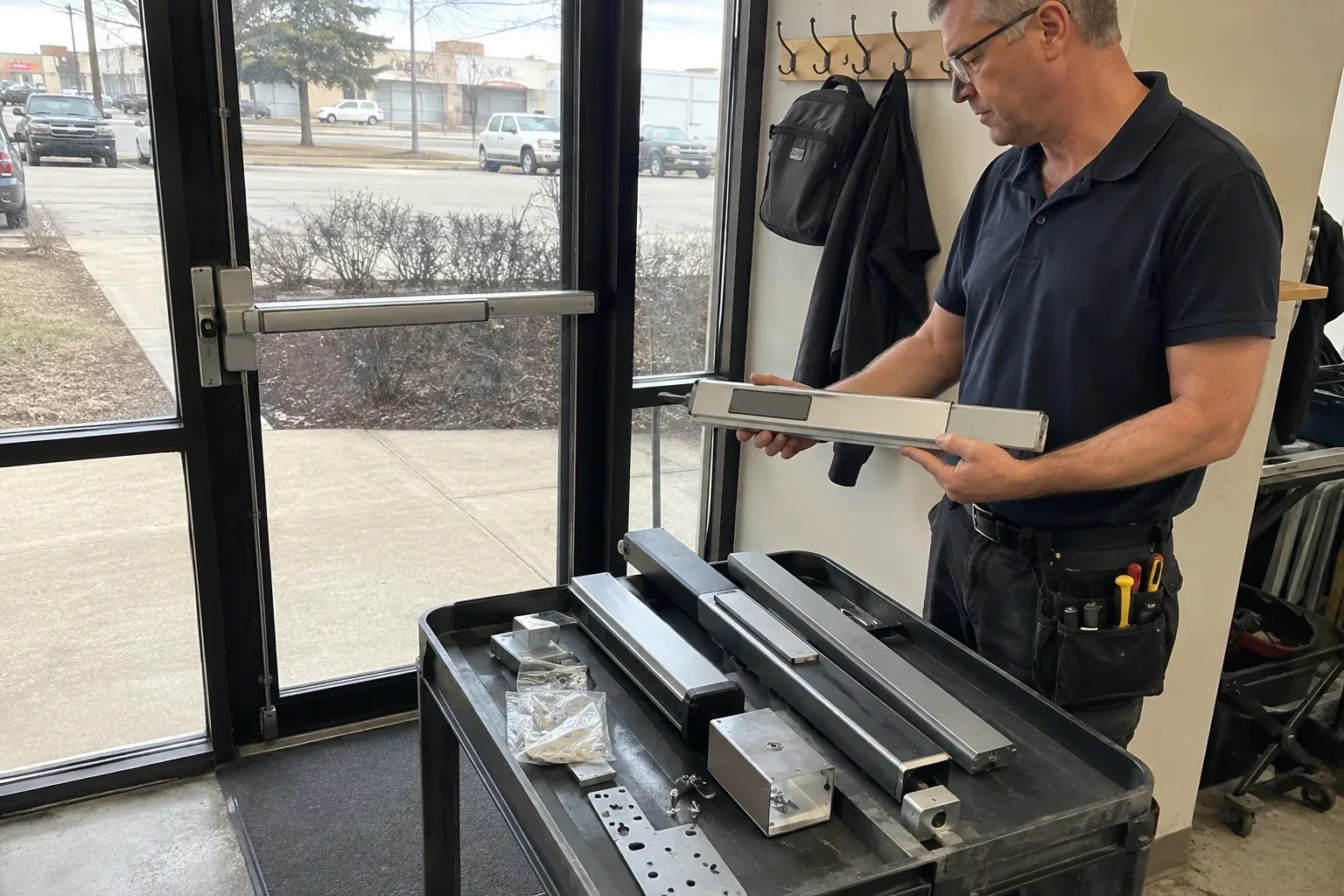
A code trigger usually starts the conversation: an occupant load over a threshold, a fire inspector's note, or a new use for a room that used to hold far fewer people. From there the visit works out which openings are affected, what device and trim suit each one, and whether a pair of doors needs a coordinator or a mullion removed. The installation follows a template, and every device is tested for release force and full latch engagement before the visit ends, with a written record of what went on the door for anyone reviewing the space afterward.
How the visit goesThe fire inspector's note is blunt: the banquet hall's second exit still turns on a deadbolt, and the crowd it is rated to hold needs a door that opens under one motion, no key involved.
Cliffcrest
How the visit goes
Checking what is already fastened to the door
A surprising number of exit-hardware calls turn up a second lock nobody had mentioned: a hasp and padlock added for security, a slide bolt at the top of a rarely used door, or a deadbolt installed long after the original exit device. Each of these has to be understood before work starts, because an exit door can only be trusted to open under one motion if every fastening on it releases the same way. The locksmith notes what is there, explains what it means for the door's exit function, and works out with the owner what stays and what comes off.
Choosing the device for the opening
With the assessment done, the locksmith matches a device family to the door: a rim exit device for most single doors, a mortise device where a heavier-duty case suits the opening, or a vertical-rod device where latching is needed at both the top and bottom of the frame. Fire-rated openings take fire exit hardware specifically listed for that duty, never a standard panic device pressed into a role it was not built for, and listed rim fire-exit hardware covers a wide range of those openings on its own. The chosen device is matched to the door's width, handing and existing preparation before it is ordered.
A door that opens under one motion, every time
What the space has afterward is straightforward: anyone inside can leave through that door with a single push on the crossbar or touchpad, no key, no second step, no need to remember which way a lock turns. Staff can be shown the motion once and it stays intuitive, because that is exactly what the hardware is built to do. Outside, entry still works the way it was set up to, through the trim chosen for that door, entirely separate from the exit function inside.
Panic & Exit Hardware
In the van
- Force gauge
- Through-fixings and mounting hardware
- Outside trim (pull, lever or cylinder)
- Rated exit device
- Request-to-exit switch
What affects the quote
Same fees day, night or weekend
1Number of openings involved
One door with a single device is the simplest case. A building with several affected exits, such as doors from a stairway plus an assembly-room exit, is quoted as the sum of each opening's own work.
2Occupancy and code documentation needed
A project with a fire inspector's note or a building official's requirement attached usually needs a more detailed written record than a straightforward upgrade an owner requests on their own initiative.
3Fire-rated versus non-rated opening
A fire-rated door needs hardware specifically listed for that assembly and installed to keep the rating intact, which is more involved than fitting a standard device to a non-rated door.
Panic & Exit Hardware: questions
What happens with a pair of doors instead of one?
It depends on the pair. Some latch independently and need nothing extra. Where the hardware calls for a set closing order, a coordinator lets the two leaves close in the right sequence, letting the active leaf's device seat properly into a strike carried on the inactive leaf, or into an astragal. Alternatively, the centre mullion can be removed and a vertical-rod device fitted to each leaf, turning the pair into one wide exit. Whichever applies, both leaves are tested working together, not one at a time.
What is dogging, and can every door have it?
Dogging holds the device's latch retracted so the door works as a simple push-pull for a period, useful during business hours on a busy entrance. It is not available on fire-rated openings, because a fire door must keep an active latch at all times; on those doors, electric latch retraction achieves a similar push-pull convenience without ever leaving the latch mechanically held back.
How is occupant load actually counted for this decision?
Occupant load is calculated from the floor area and the intended use of the room, using published factors for that occupancy type, rather than a headcount taken on a busy night. A building official or a locksmith familiar with the calculation can work through it for a specific room, and the result is what decides whether the exit doors serving that room need a releasing device.
Commercial Locks
- Master Key System DesignOn the warehouse floor, a shift supervisor's key opens the loading dock, the tool crib and the…
- Access Control InstallationSomething went missing from the storeroom over a weekend, and when you ask who was in the building…
- Commercial-Grade Lock ReplacementAn inspection report flagged the rear exit as needing hardware that opens with one motion and no…
Panic & Exit Hardware near you
In Cliffcrest the work spans everything on a door that turns, latches or bolts. Homes: lockouts, rekeys, replacements, deadbolts, smart locks, heritage hardware. Businesses: storefront locks, exit devices, closers, master key systems, safes. Read the service that fits and see how a visit runs from start to finish.